Why Flat Roofing Solutions for Businesses are the Modern Standard
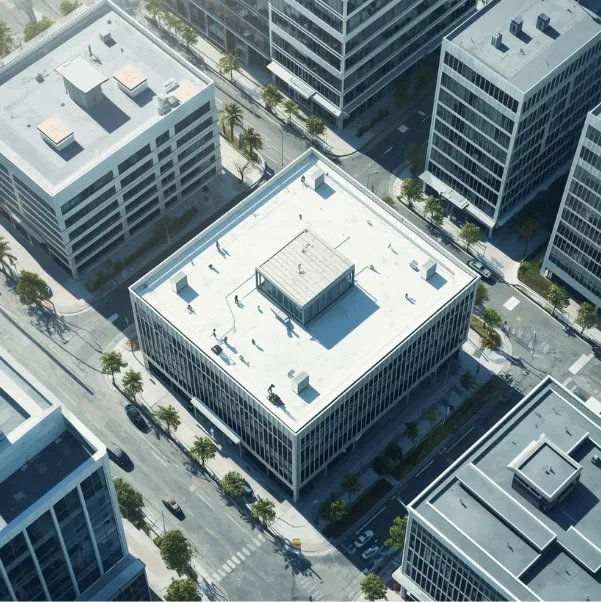
For the majority of commercial and industrial buildings across Oklahoma City, the roofline is distinctly different from their residential counterparts. While traditional pitched roofs are dominant on homes, the sprawling warehouses, office complexes, retail centers, and manufacturing plants that form the backbone of our economy overwhelmingly rely on flat or low-slope roofing systems.
This choice is not merely an aesthetic one; it is a calculated decision based on economics, engineering, and functionality. Choosing the optimal system from the array of Flat Roofing Solutions for Businesses is one of the most vital capital investment decisions a property owner or manager will make.
At Total Restoration, we are experts in both flat and traditional roofing, and we understand that each system serves a distinct purpose. This in-depth guide is designed to empower you to navigate the advantages, disadvantages, and specific material choices of modern flat roofing, ensuring your business invests in a system that is resilient, energy-efficient, and engineered to thrive in the harsh Oklahoma climate.
Flat vs. Pitched: Defining the Commercial Advantage
While traditional pitched roofs (with slopes steeper than 2:12) are excellent for positive water drainage and creating attic space for insulation, they are structurally impractical and cost-prohibitive for large commercial footprints. This is where modern flat roofing takes the clear lead.
The Key Advantages of Flat Roofing for Commerce
Cost-Effective Installation: Flat roofing systems typically require less material and less complex structural support than steep-slope alternatives. This reduces the initial construction costs significantly, making them the most economical choice for large industrial and commercial facilities.
Usable Space Optimization: This is perhaps the greatest practical advantage. The flat surface provides essential, easily accessible real estate for vital mechanical systems, including HVAC units, exhaust fans, and cooling towers. It is also the ideal platform for installing high-efficiency solar panel arrays.
Maintenance and Accessibility: A flat surface is safer and easier for technicians to access and work on. Routine inspections, debris removal, and essential maintenance on rooftop units are simplified, lowering labor costs and ensuring prompt attention to potential issues.
Wind Resistance: When correctly installed and adhered to the deck, Flat Roofing Solutions for Businesses generally offer superior resistance to wind uplift compared to the perimeter of a pitched roof, a critical factor in Oklahoma’s high-wind environment.
The Material Science of Flat Roofing Solutions for Businesses
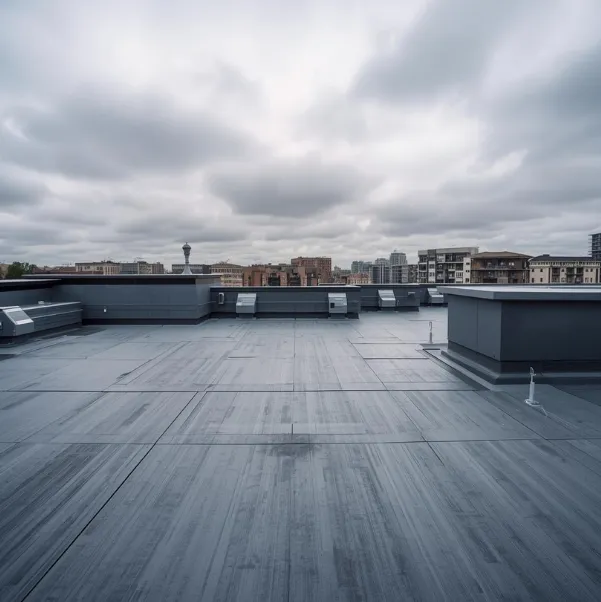
Modern flat roofing is a world away from the leaky "tar-and-gravel" systems of the past. Today's solutions utilize advanced synthetic materials engineered for decades of performance, flexibility, and extreme weather resistance.
1. Single-Ply Membranes: The Modern Workhorse
These systems utilize large, flexible sheets of material that are either adhered, mechanically fastened, or ballasted to the roof deck, with seams meticulously sealed to form a monolithic waterproof barrier.
TPO (Thermoplastic Polyolefin): TPO is the current market leader due to its outstanding energy efficiency and affordability. The white surface provides high solar reflectivity, reducing heat absorption and significantly lowering a building's cooling costs—a massive return on investment during Oklahoma's long, hot summers. The seams are heat-welded, creating a bond stronger than the membrane itself.
EPDM (Ethylene Propylene Diene Monomer): Known as "rubber roofing," EPDM is a robust, durable thermoset elastomer. While typically black (though white is available), it is highly resistant to UV radiation, thermal shock, and ozone, offering a proven lifespan of 25–30 years with minimal maintenance.
PVC (Polyvinyl Chloride): Similar to TPO, PVC is known for its exceptional resistance to chemicals, grease, and fire, making it the preferred choice for restaurants, food processing plants, and industrial facilities with potential rooftop grease exhaust.
2. Modified Bitumen (Mod-Bit) and Built-Up Roofing (BUR)
These are the evolutionary descendants of traditional flat roofing.
Modified Bitumen: This system uses asphalt that is modified with polymers (either rubber or plastic) for added flexibility and strength. It’s often installed in layers and finished with a granular surface or a reflective coating, offering excellent waterproofing and resistance to foot traffic.
Built-Up Roofing (BUR): The original "tar and gravel" system. BUR uses multiple layers of felt fabric laminated together with asphalt or coal tar, topped with gravel. While older, its multi-layer redundancy offers robust waterproofing and superior fire resistance.
3. Fluid-Applied Coatings: The Restoration Ace
For business owners seeking to extend the life of an existing, functional roof without the capital outlay of a full replacement, elastomeric coatings are a game-changing solution and a specialty service offered by Total Restoration.
Seamless Restoration: High-performance silicone or acrylic coatings are applied directly over an aging TPO, EPDM, or metal roof. They cure to form a seamless, monolithic, liquid-applied membrane that is highly reflective and water-resistant.
Cost Efficiency: Commercial Roof Restoration OKC via coating is typically 50% to 70% less expensive than a tear-off and replacement, making it an incredibly smart approach to managing budgets while gaining a new, warrantable surface.
The Critical Challenge: Water Management in Flat Roofing
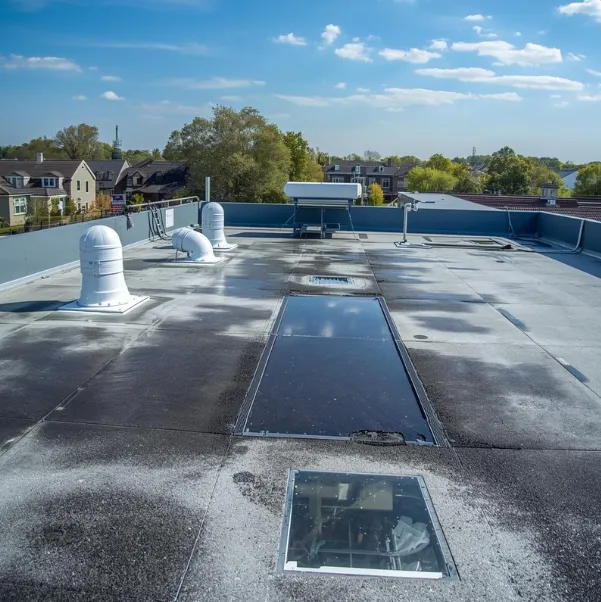
The single most common concern regarding Flat Roofing Solutions for Businesses is drainage. While a pitched roof relies purely on gravity to shed water, a flat roof (which actually has a slight slope, usually 1/4 inch per foot) requires meticulous engineering to prevent "ponding" or standing water, which accelerates material degradation.
Engineering Solutions for Optimal Drainage
Tapered Insulation: A professional installation integrates tapered insulation boards beneath the membrane. These rigid boards are installed with varying thickness to deliberately create the perfect slope and direct water toward the interior drains or exterior scuppers. This is non-negotiable for true long-term performance.
Strategic Drain Placement: Interior drains must be strategically placed at the lowest points of the roof surface. Total Restoration’s engineering review ensures drain capacity meets or exceeds local codes for intense Oklahoma storm events.
Scuppers and Gutters: Exterior drainage systems (scuppers leading to downspouts) must be adequately sized and kept clear of debris, particularly in the corners and perimeter where wind-driven rain can be an issue.
Failure to properly engineer drainage leads to premature warranty issues. This focus on water management is a hallmark of expert, reliable roofing services.
Total Restoration: Mastering Flat Roofing Solutions for Businesses in OKC
Selecting a roofing partner means choosing a firm that understands the technicalities of flat roofs and the financial pressures of running an Oklahoma business. Total Restoration brings a unified approach of technical mastery and business advocacy.
A. Advanced Diagnostics and Proactive Maintenance
We don't wait for a leak to tell us your roof is failing. We leverage advanced tools to provide proactive asset management:
Infrared Surveying: We use infrared cameras to detect thermal anomalies caused by moisture intrusion. This allows us to pinpoint and remove isolated areas of wet insulation without having to tear up the entire roof, offering precise and cost-effective Commercial Roof Repair OKC.
Customized Maintenance Plans: We offer scheduled maintenance that is vital for flat roofs. This includes annual drain cleaning, seam inspections, and proactive repairs around curbs and penetrations, ensuring your manufacturer's warranty remains intact and maximizing the lifespan of your system.
B. Manufacturer-Certified Quality Assurance
Our teams hold the highest certifications from leading single-ply membrane manufacturers. This means:
Guaranteed Installation: Our work is verified by the material manufacturers, ensuring that welding temperatures, seam overlaps, and fastening patterns meet the stringent requirements necessary for high-wind environments.
The Best Warranty: Our certified status allows us to offer the longest, most comprehensive warranties available—often non-prorated for up to 25 years. This level of protection is essential for your long-term business continuity.
C. Minimizing Business Interruption
We understand that time is money. Our project management focuses on minimal operational impact:
Efficient Scheduling: We coordinate work schedules with your operations team to minimize noise and disruptions, often staging complex work during non-peak hours.
Safe Site Management: Strict OSHA compliance and meticulous site logistics ensure employee and customer safety around the work zone, allowing your business to continue running smoothly.
Finalizing Your Flat Roof Strategy
The modern flat roof is a highly efficient, technically advanced solution that provides the best value and functionality for the vast majority of commercial buildings. Maximizing the return on this investment requires moving beyond price shopping and focusing on the contractor’s specialized expertise in flat roof engineering, material certification, and local climate resilience.
Partnering with Local Roofing Experts in Oklahoma City like Total Restoration ensures you receive a solution that is engineered for the heat, wind, and financial demands of running a business in the heartland.
Schedule Your Quality Roof Assessment Today.
Ready for real value? Simply fill out the form for a professional roof assessment and receive your honest, detailed quotefor any neededwork.
